
Introduction
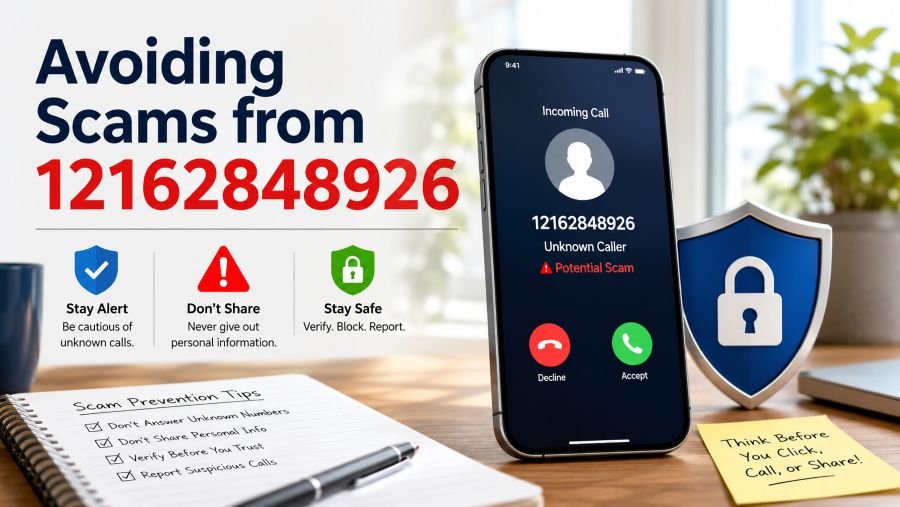
Receiving an unexpected call from 12162848926, also written as (216) 284-8926, can naturally make you wonder who is calling and whether it is safe to answer.
Public information about this number is limited. A current phone-number lookup from Nomorobo identifies it only as an unknown caller, rather than providing a verified person or business behind it.
That does not automatically prove that every call displaying this number is fraudulent. Caller ID information can be changed or spoofed, meaning the number shown on your screen may not be the real source of the call. The Federal Communications Commission warns that scammers often use this technique to make calls look more trustworthy or local.
For that reason, avoiding scams from 12162848926 is mainly about knowing how to handle any unexpected caller safely.
Quick Facts
| Quick Fact | Details |
|---|---|
| Number | 12162848926 |
| Common format | (216) 284-8926 |
| Public identification | Unknown caller in a current Nomorobo lookup |
| Verified owner | No reliable owner identified in the sources reviewed |
| Main concern | Unexpected or suspicious phone communication |
| Caller ID reliable? | Not always |
| Caller ID spoofing possible? | Yes |
| Should you share passwords? | No |
| Should you share banking details? | No |
| Should you share security codes? | No |
| Safe response | Hang up and verify independently |
| Call blocking | Useful for unwanted calls |
| Reporting | Suspicious calls can be reported to relevant authorities |
| Best protection | Do not act under pressure |
What Do We Know About 12162848926?
At the time of research, there is not enough reliable public evidence to connect this telephone number with a confirmed company or individual.
Nomorobo’s current lookup describes 216-284-8926 as an unknown caller.
This is important because an unknown number should be treated carefully, but it should not automatically be accused of fraud.
Another important point is caller ID spoofing. The number displayed on your phone may sometimes be different from the number that actually placed the call.
The FTC explains that scammers can make almost any name or telephone number appear on caller ID. A call that seems local can therefore come from somewhere completely different.
Why Unknown Phone Calls Can Be Risky
Many legitimate organizations make telephone calls. Doctors, delivery companies, banks, schools, businesses, and government offices may contact people by phone.
Scammers use the same communication method.
The difference is often found in what the caller asks you to do.
Be especially careful if an unexpected caller wants you to:
- Give your bank account or card details.
- Reveal a password or PIN.
- Read out a one-time security code.
- Provide your Social Security number or other identity information.
- Send money immediately.
- Buy gift cards.
- Transfer cryptocurrency.
- Install an unknown application.
- Give remote access to your computer.
- Click a link sent during the conversation.
- Make a decision immediately.
The FTC specifically warns consumers about callers demanding unusual payment methods such as gift cards, cryptocurrency, payment apps, or wire transfers.
Do Not Trust Caller ID Alone
One of the biggest mistakes people make is assuming that the telephone number shown on the screen proves who is calling.
It does not.
Caller ID spoofing allows someone to change the information displayed to the recipient.
A scammer could potentially make a call appear to come from:
- A local telephone number.
- A bank.
- A government department.
- A police department.
- A familiar company.
- Another innocent person’s number.
The FTC advises consumers not to rely on caller ID when deciding whether an unexpected call is genuine.
This means that even if you have previously seen 12162848926 associated with suspicious activity online, the actual caller may be using a spoofed number.
What Should You Do If 12162848926 Calls?
If you receive an unexpected call, you do not have to answer.
Allowing an unfamiliar number to go to voicemail is often a simple first step. The FTC also recommends hanging up if you answer a call and do not recognize the person or if the conversation becomes suspicious.
If you do answer, stay calm.
Listen without giving away private information.
A genuine organization should normally allow you to independently verify who they are.
For example, if the caller claims to represent your bank, do not use a telephone number supplied by the caller. End the conversation and contact your bank using the official number printed on your card or shown in your official banking app.
The same principle works for government departments, insurance providers, delivery services, and other companies.
Watch for Urgent Language
Scammers commonly try to stop people from thinking carefully.
They may say things such as:
“Act now.”
“Your account will be closed.”
“Your payment is overdue.”
“Your benefits will stop today.”
“Your computer has been hacked.”
“Someone is using your bank account.”
“You have won a prize.”
“Do not tell anyone about this call.”
Urgency does not prove that a call is fraudulent, but unexpected pressure is a strong reason to stop and verify the situation independently.
The FTC advises people to hang up when an unexpected caller pressures them to act immediately.
Never Give Out One-Time Security Codes
A verification code sent to your phone or email is often designed to prove that you are trying to access an account.
Never read these codes to an unexpected caller.
A person asking for your login code may be attempting to enter your email, banking, social media, or another online account.
Passwords, PINs, recovery codes, and authentication codes should remain private.
What If the Caller Claims to Be From Your Bank?
Do not immediately believe the claim.
Hang up and contact the bank yourself.
Use an official contact method that you already trust.
Check your banking application or account directly for suspicious transactions.
Never move money simply because someone calling you says your account is in danger.
Scammers sometimes create fear by claiming that money must be transferred to a “safe account.” A genuine safety check should be independently verified with your financial institution.
What If You Already Shared Information?
The correct response depends on what you shared.
If you revealed a password, change it immediately. If the same password is used elsewhere, change those accounts too.
If banking or card information was provided, contact your bank or card provider as soon as possible.
If you gave someone access to an online account, review your security settings, connected devices, recovery details, and recent login activity.
If money was sent, contact the company, bank, payment service, or financial institution involved immediately. The FTC notes that quick action may sometimes improve the chance of recovering money, depending on the payment method.
Should You Call the Number Back?
Calling an unfamiliar number back is usually unnecessary when you do not know who contacted you.
If the caller claimed to represent an organization, find that organization’s official contact information independently.
Do not rely on a callback number provided during a suspicious call.
Remember that the telephone number displayed on caller ID could have been spoofed.
Blocking Unwanted Calls
If calls continue and you have no reason to communicate with the caller, blocking the number may help.
Modern smartphones and telephone providers commonly provide call-blocking or spam-labeling features.
The FTC recommends call-blocking and call-labeling technology as useful tools for reducing unwanted calls.
However, blocking one number cannot stop every scam call because callers may change numbers or use spoofed caller IDs.
Can the Do Not Call Registry Stop Scammers?
In the United States, the National Do Not Call Registry can help reduce legitimate sales calls.
It cannot stop every fraudulent call.
The FTC explains that scammers may ignore the registry because they are already breaking the law.
Therefore, call screening and careful verification are still important.
How to Report a Suspicious Call
Keep basic information about the incident if you believe a call was suspicious.
Useful details may include:
- The number displayed on caller ID.
- The date and time.
- What the caller claimed.
- Any callback number provided.
- What payment was requested.
- Whether a text message or link was sent.
The FTC advises reporting the caller ID number even when you believe it may have been spoofed because reports can still help investigators identify calling patterns.
Is 12162848926 Definitely a Scam Number?
There is not enough reliable evidence to make that absolute statement.
The most responsible conclusion is that 12162848926 should currently be treated as an unverified caller.
Public lookup information does not clearly identify its owner, and caller ID spoofing makes it difficult to prove who actually placed a particular call.
Instead of focusing only on the displayed number, judge the situation by the caller’s behavior.
Requests for money, passwords, account details, verification codes, remote device access, or immediate action should be treated with extreme caution.
Common Questions
Who called me from 12162848926?
Reliable public sources reviewed for this article do not identify a confirmed owner. A current Nomorobo lookup lists (216) 284-8926 as an unknown caller.
Should I answer 12162848926?
If you do not recognize the number, you can allow the call to go to voicemail. If you answer, avoid providing private or financial information until you independently verify the caller.
Can this number be spoofed?
Yes. Like other telephone numbers, a caller ID displaying this number could potentially be spoofed. The FCC and FTC both warn that caller ID information can be manipulated.
Should I block the number?
If the calls are unwanted or repeatedly suspicious, blocking it can be a reasonable step. Remember that blocking one number cannot prevent callers from using other numbers.
What should I do if the caller asks for money?
Do not send money during an unexpected call. End the conversation and independently verify the organization or situation first.
What if they know my name?
Knowing your name does not prove that a caller is genuine. Personal information may come from public records, online accounts, marketing databases, or previous data exposure.
Final Thoughts
Avoiding scams from 12162848926 starts with a simple rule: verify before you trust.
There is currently no strong reliable evidence identifying the owner of this number. More importantly, the number appearing on your phone may not prove who actually made the call because caller ID can be spoofed.
Do not provide passwords, PINs, banking information, identity details, or security codes to an unexpected caller.
If someone claims to represent a trusted company or organization, end the call and contact that organization through an official method you find independently.
A few minutes of checking can protect your money, accounts, and personal information.







Leave a Reply